To the Experts Corner
Ship to Shore: How to Simplify Audit Readiness

What does real-time ship-to-shore logging mean for post-incident reporting and compliance?
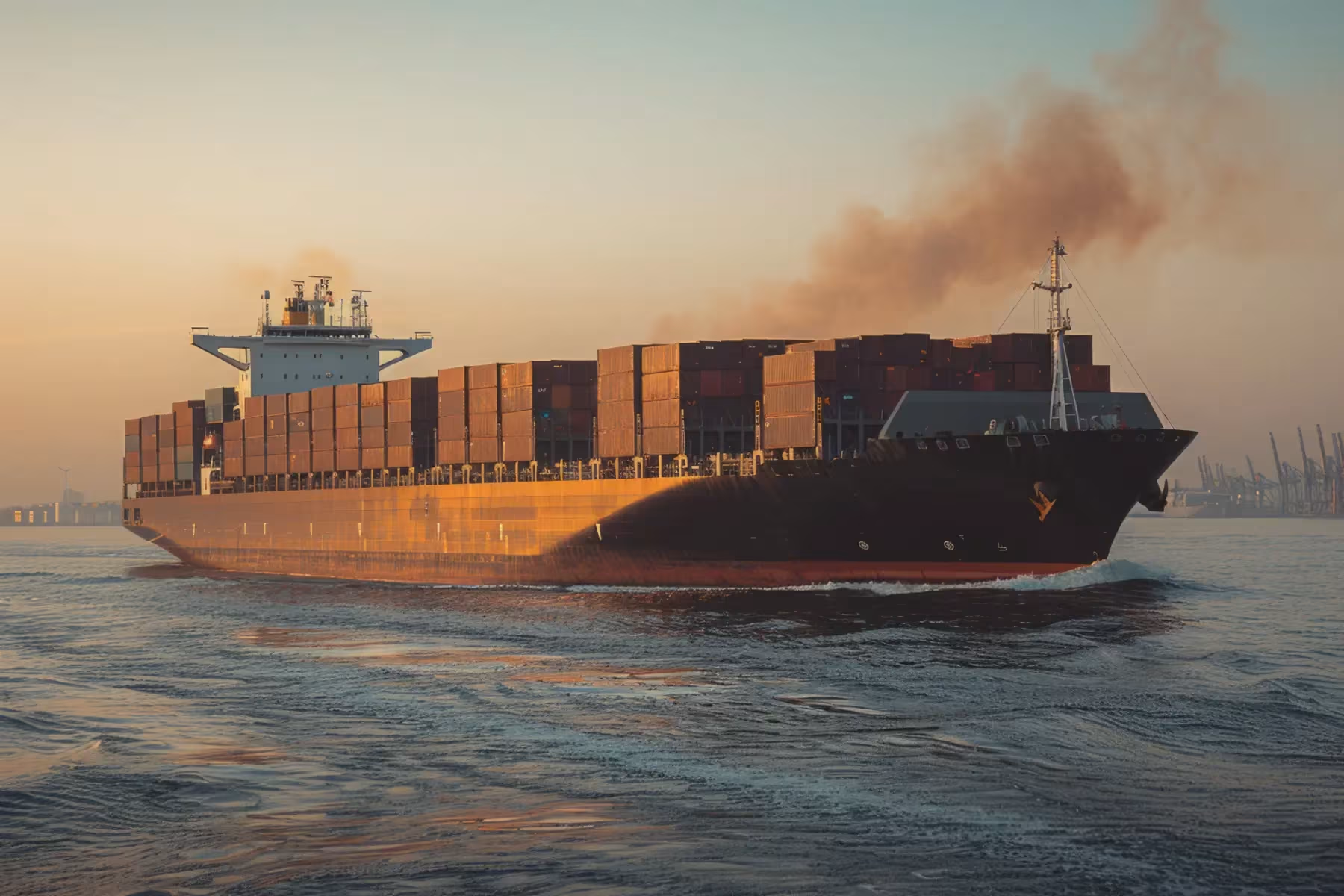
The Norwegian Maritime Authority recorded 589 commercial incidents in the first six months of 2025, with groundings up 54 percent on the previous year. Globally, the Allianz Safety and Shipping Review recorded 250 fire incidents in 2024, a 20 percent increase and the highest in a decade. Both trends have structural causes that aren’t going away. Groundings are rising partly because retreating Arctic ice is opening new routes in less-charted, more environmentally sensitive waters. And fires are on the increase, in part, because of the surge in lithium-ion battery and EV cargo — a different category of fire risk entirely.
Each incident — grounding or fire — triggers a cascade of questions from multiple directions at once: the flag state, the P&I club, port state control, and cargo owners.
What happened, in what sequence, who knew what and when, and what was done about it?
How quickly and completely your organisation can answer those questions depends entirely on what was captured during the response.
Where reconstruction breaks down
On the evening of 14 February 2026, the cargo vessel Diezeborg suffered an engine room fire in the Baltic Sea northwest of Gotska Sandön. The crew extinguished the fire but lost power and became unmanoeuvrable, drifting toward shallow water before the Swedish Coast Guard connected a towline shortly before 3am. The unfolding incident posed environmental risks because the area around Gotska Sandön is a national park and a Natura 2000 site. And the cargo was zinc concentrate. Fortunately, the situation was brought under control when the Swedish Coast Guard took Diezeborg under tow to prevent it from drifting onto the shoals at Kopparstenarna. All people on board were reported safe, with no injuries.
It ended well, but incidents such as this don’t just test emergency response — they test whether a company can produce a defensible record of that response under pressure. An engine room fire with loss of propulsion, grounding risk, environmental exposure, and an undetermined cause involves the flag state, the P&I club, maritime and environmental authorities, the classification society, and the cargo owner — all requiring a clear, verified account of what happened and how the response was conducted.
Under a shore-side-only model, building that account means reconciling the master’s account with the DPA’s notes, working the phones, and assembling a timeline from fragments that were never captured in a single place. That takes days. And what it produces is not a verified record, but a reconstruction — one that can be challenged, questioned, and, in the worst case, fails under scrutiny.
What regulators ask for
The ISM Code has required shipping companies to maintain documented evidence of safety management since 1998 — not just that incidents were investigated, but that corrective actions were verified. The record needs to show what was decided, what was done, by whom, and when.
P&I clubs, flag states, and port state control ask the same questions. Under Norwegian law, if acute pollution occurs or threatens to occur, a response plan must be submitted to the Norwegian Coastal Administration within one hour. MARPOL imposes its own documentation requirements. Cargo owners want to know what happened to their shipment. The standard across all of them is the same: not whether your people were competent, but whether you can demonstrate what happened in a form that stands up to scrutiny.
Most organisations discover the gap between those two things at the worst possible moment — in the middle of a post-incident review, when the questions are already being asked and the reconstruction is already underway. Not because the requirements are unclear, but because the way incidents are managed has not kept pace with what regulators now expect.
Beyond the incident
This is the practical value of integrated ship-to-shore incident management: not just a faster report, but a record complete enough to support the debrief, the procedure update, and the next drill. The ISM Code’s continuous improvement obligation and the growing demand from ESG frameworks for documented evidence of how incidents were managed both depend on the same thing — a record built during the response, not assembled after it.
Audit readiness isn’t a reporting exercise. It’s a byproduct of how you manage the incident itself. Organisations that treat documentation as something to assemble afterwards will always be slower, less certain, and more exposed under scrutiny.
Organisations that build the record in real time demonstrate with evidence that they are prepared: when the questions come, the answers already exist.
Pro tip
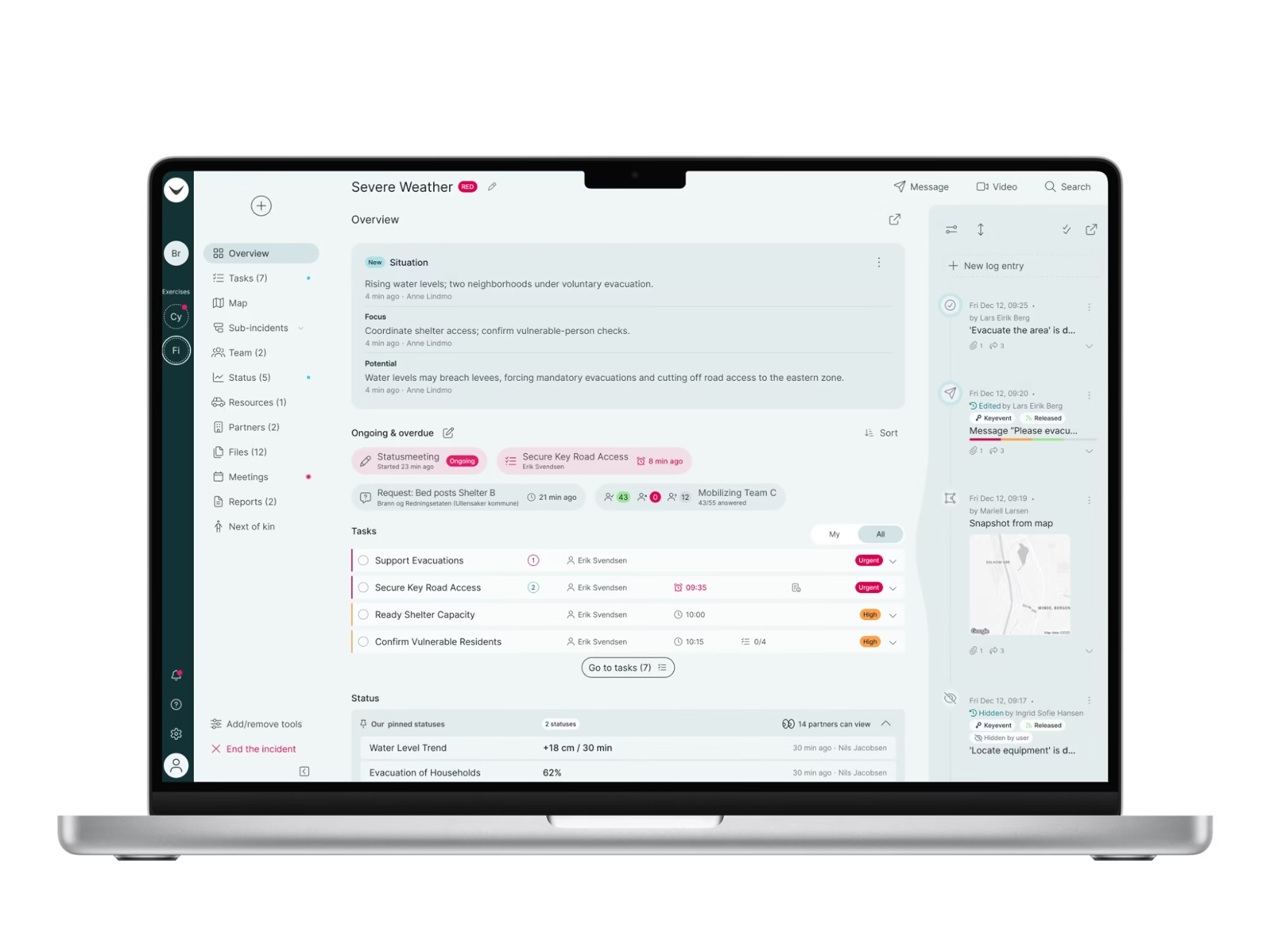
Integrated ship-to-shore incident management means one consolidated, time-stamped log — audit-ready the moment the incident closes.
Common questions about maritime audit readiness
What does the ISM Code require after an incident?
Documented evidence of safety management, in force since 1998. Not only that incidents were investigated, but that corrective actions were verified. The record has to show what was decided, what was done, by whom, and when.
Who asks for an account of a maritime incident?
Typically several parties at once: the flag state, the P&I club, port state control, the classification society, maritime and environmental authorities, and the cargo owner. Each wants a clear, verified account of what happened and how the response was conducted, and they rarely wait for one another.
How quickly must a pollution response plan be submitted in Norway?
Within one hour. Under Norwegian law, if acute pollution occurs or threatens to occur, a response plan must be submitted to the Norwegian Coastal Administration within that window. MARPOL imposes its own documentation requirements alongside it.
What is the difference between a record and a reconstruction?
A record is captured as the response happens and is time-stamped at the moment of each action. A reconstruction is assembled afterwards from the master’s account, the DPA’s notes, and phone logs. The first can be produced on request; the second takes days and can be challenged, because it depends on memory rather than evidence.

- Norwegian Maritime Authority (Sjøfartsdirektoratet). 589 commercial incidents recorded in the first six months of 2025, with groundings up 54 percent year on year.
- Allianz. Safety and Shipping Review. 250 fire incidents recorded in 2024, a 20 percent increase and the highest in a decade.
- International Maritime Organization. International Safety Management (ISM) Code, in force since 1998. Documented evidence of safety management and verification of corrective actions.
- Norwegian Coastal Administration (Kystverket). Requirement to submit a response plan within one hour where acute pollution occurs or threatens to occur.
- International Convention for the Prevention of Pollution from Ships (MARPOL). Documentation requirements.
Talk to a RAYVN Expert
Don't just test a tool—optimize your strategy. Sit down with a RAYVN expert to verify our features meet your compliance needs and see how easy it is to manage complex incidents in real-time.
Get Started