All blog posts
Emergency Response Coordination: What Responders Need

Your emergency response network needs to coordinate effectively, even with people who are not part of the core team when a situation escalates. We took a closer look at how to prepare for the unexpected demands of real-time response and recovery.
Take the Coordination gap identifier
Start now →Effective emergency response coordination is tested most when an incident pulls in people who were never part of the core team. In December 2023, a major pollution incident at Kongsberg Municipality required an immediate response. Personnel not typically involved in crisis management had to provide input urgently. There was very little time for training or mobilisation.
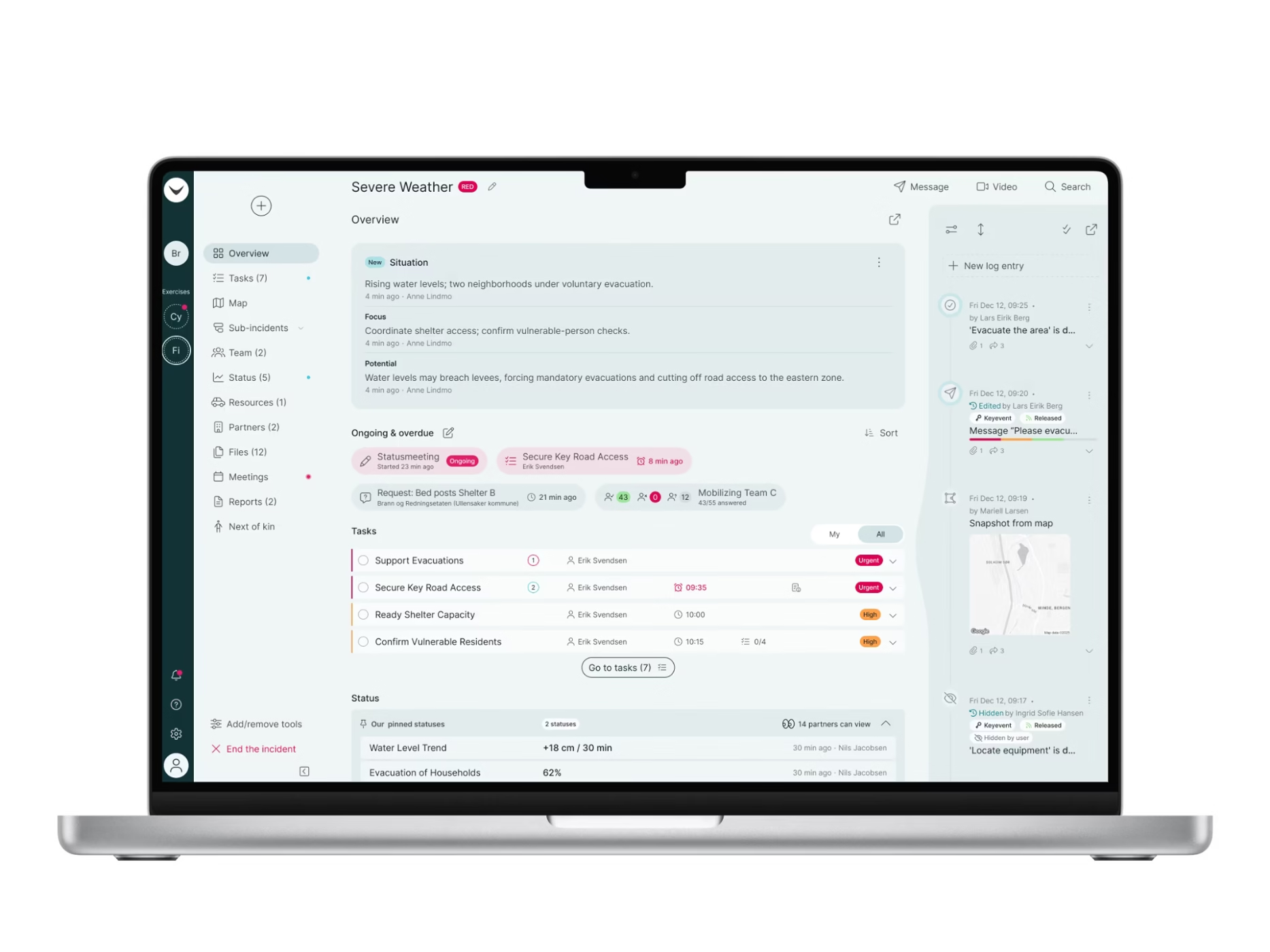
Accounts were set up for external partners on the fly, and within minutes they were logging updates, sharing photographs, and working alongside the internal team in real time. The response held. Not because everyone knew the system from prior training, but because the system was designed to work for people encountering it under pressure for the first time.
What made the difference at Kongsberg was not just training. It was also a solution that worked for people who had never used it before, under pressure, without time to orient. When response networks fail in complex incidents, the cause is more often a failure of coordination than a lack of knowledge:
- information that does not reach the right people
- roles that are unclear at activation
- teams that have never practised together in conditions close enough to the real thing
Inside the Emergency Response Network
Modern incident response involves a layered network of people with different roles, different activation frequencies, and different relationships to the organisation.
Internally, there are people whose response roles are part of their daily working identity, including emergency medical teams, security officers, operations and facilities staff. Their challenge is coordination under pressure:
- to maintain a shared operational picture
- to manage task ownership
- to escalate decisions without losing the thread
The Emergency Response Network
Operational responders — who they are, and what they need. Click any role to see its coordination need.
Internal operational responders
External emergency response
What each position requires
Daily professional
- Situational awareness that keeps pace — filtered to their function
- Task ownership across a complex network
- Coordination without cognitive overhead
- Fast, documented escalation paths
Occasional / variable
- Rapid orientation on activation
- Role memory under pressure
- Platform familiarity despite long gaps
- Confidence that actions are being captured
What the platform must deliver
- Role-appropriate information, same system in exercises and live incidents
- Immediate clarity on activation
- Actions captured automatically
- No specialist knowledge required
- A shared operational picture throughout
Because every action counts.
Specialists, whose participation depends on the nature of the incident, may be embedded in the team or mobilised as and when needed. IT and cyber security teams respond daily to minor events as well as more serious incidents. These members of the emergency response network may lack the same familiarity as everyday responders, even as they must work under time pressure that leaves no room for orientation.
Externally, agencies and services, such as emergency services, search and rescue teams, and environmental spill response personnel, may be called upon to respond. They bring specialist capability and statutory authority, along with their own command structures and communication protocols.
To offer an example, CCB Ågotnes, a large port facility near Bergen with more than sixty tenants and four companies operating a shared industrial safety organisation, works with an extended emergency response network. ‘Our personnel are mechanics, operators, office workers, and engineers — and we need to be able to reach them all and know which resources and capacities we have available on a given day,’ said Daniel Ayala Høydal, Security and Preparedness Manager.
The 2023 exercise at CCB brought together fire, health, police, the municipality, the Red Cross, and two private security firms — more than seventy people responding to a single scenario involving fire, a power cut, and ten casualties. This complex network of responders, consisting of internal and external personnel, needs to work together easily. By training together, preparedness and coordination are put to the test.
Challenges: situational awareness and cognitive overload
But not all emergency response networks are fully prepared. Under pressure, responders need to be able to participate in joint decision-making and coordinate seamlessly with other agencies. When coordination breaks down during an incident, gaps are exposed. This can look like confusion about who owns a task, an update sent to the wrong channel, or a team working from an incomplete understanding of the situation.
Research on team cognition in emergency response teams confirms that the two highest-weighted factors affecting performance in mixed ERTs are team maturity and the 4Cs:
- Communication: the exchange of information, situational awareness, and instructions between team members and across organisational levels. In emergency response, this includes both the transmission of accurate information and the confirmation that it has been received and understood.
- Coordination: the structured allocation and sequencing of tasks across team members so that individual actions combine into an effective collective response. Coordination requires shared understanding of who is doing what, in what order, and within what time constraints.
- Cooperation: the willingness of team members and organisations to work toward shared goals, including sharing resources, information, and decision authority across boundaries. Cooperation is the disposition that makes coordination possible — particularly in multi-agency and multi-organisational response.
- Collaboration: the joint production of decisions, plans, and responses through active mutual engagement. Where cooperation is a willingness and coordination is a structure, collaboration is the active working-together that produces outcomes neither party could achieve alone.
Improper training programmes are the most independent causal factor — they drive the other failures (Esmaeili et al., Frontiers in Psychology, 2025). Training builds individual capability. Coordination under pressure is built through shared practice.
Responders: mapping differences and needs
To coordinate effectively, any incident manager should begin by mapping the responders in the network and their operational requirements. The diagram above provides a framework: three layers, each with distinct coordination challenges, each requiring something different from the infrastructure.
- For daily professionals, the requirement is situational awareness that keeps pace — filtered to their function, not the full record.
- A security officer needs to know where the hazard boundary is.
- A facilities team needs the headcount.
- Task ownership must be explicit and visible.
- Escalation paths must be fast and documented.
For occasional and embedded responders, the challenges are different in kind. Orientation at activation — what has happened, what is underway, what do I do now. Role memory under pressure — not the role in principle but what it requires in this specific incident. Platform familiarity despite long gaps between activations. And confidence that actions are being captured, which is a cognitive load that sits on top of the incident itself.
That mapping exercise has a direct output: it tells the incident manager where the gaps are before an event, what training and exercise design needs to address, and what the platform must deliver for each role. Dag E. Snemyr, HSEQ Director at SIEM Offshore, put the network requirement precisely: ‘RAYVN can be used both by the crisis management team and first-line responders, but also by new partners entering the collaboration during an ongoing crisis. This means that everyone involved in crisis management can make real-time decisions based on the same information, and everyone has up-to-date information at all times.’
What coordination failure looks like
Without a shared platform, personnel in the situation room ‘often feel like they are working blindly — restricted to reviewing maps or site drawings,’ as Daniel Ayala Høydal at CCB describes. The field team and the command team are managing the same incident from different pictures. Gisle Rong, CEO of Seatrans, described what that looks like in practice: ‘We don’t end up with a whole puzzle of text messages, yellow sticky notes, and email copy-paste to reconstruct the series of events in retrospect.’ Multiple channels, each carrying partial information, all requiring someone to synthesise manually under pressure.
Svein Erik Malkenes, attests to how a frictionless solution can support responders: ‘Using RAYVN leads to radio silence. The ability to give quiet feedback and communication — that is something we really appreciate during otherwise very stressful days.’ Pål Thorstensen, Security Manager at Norsea Group, notes that ease-of-use simplifies coordination because the solution is ‘so user-friendly that our personnel has not needed to attend any course to get operational with RAYVN.’ In a network that includes contracted specialists and external agencies, the ability to function without prior training is not simply a convenience. It makes the difference between a response that succeeds and one that fragments.
Build Your Emergency Response Network Before an Incident
Organisations that respond well to complex incidents build out the emergency response network before the event. External partners are on the same platform, connected and practised. They exercise through the same infrastructure used for live incidents — so that every person who responds activates in a familiar environment. And when an incident happens, the log builds itself.
Gunhild Fundal at Sira-Kvina has described what that meant in practice: while she and her deputy were both unavailable, other members of the emergency response team were able to assume their responsibilities and handle the incident effectively. The platform enabled coordination even when key personnel were absent.
That is not an unusual scenario. Turnover erodes response capability quietly: the person who attended the training has left, and the person now holding that role may be encountering the platform for the first time in a live incident. The same applies to external responders arriving mid-event, contractors joining a response already underway, and agencies entering at different stages of an escalating situation.
Whether they are underprepared for the incident or new to the technology, the critical event management platform needs to enable responders to pull together easily.
Whether capability translates to an effective response depends on real-time coordination. When an incident unfolds, does the team have a shared understanding of the situation, roles, information flows, and what each person is doing?
Research on geographically dispersed emergency medical teams found that coordinating mechanisms, specifically shared mental models, matter more than individual team processes for performance (Johnsen et al., Frontiers in Psychology, 2022). A separate randomised controlled study found that training specifically designed to build shared mental models produced significant improvements in task coordination and decision-making — while conventional simulation training improved technical skills but not the coordination layer (Friederich et al., Journal of Medical Education and Curricular Development, 2025).
Mapping the responder by their operational participation and needs tells the incident manager where coordination gaps are likely to appear before an event: which personnel need to coordinate, which layers of the network have never practised together, and where the shared preparedness is thinnest. Such gaps are precisely what training and exercise design should be designed to address.
But the mapping exercise also identifies something the training programme alone cannot fix: the people who will encounter the system for the first time under pressure, because they arrived after the training, or because their role rarely activates, or because they came from outside the organisation. For those people — and in any serious incident there may be some — an incident management platform provides continuity. Not a fallback. The chosen critical event management solution helps to determine whether the response holds even when preparedness lags or falters.
Because every action counts.
Common questions about emergency response coordination
What is an emergency response network?
It is the layered set of people who respond to an incident, not only the core crisis team. Modern incident response involves people with different roles, different activation frequencies, and different relationships to the organisation: internal responders such as emergency medical teams, security officers, operations and facilities staff; specialists such as IT and cyber security teams, embedded or mobilised as needed; and external agencies including emergency services, search and rescue teams, and environmental spill response personnel.
Why does emergency response coordination break down during a major incident?
Coordination usually fails before knowledge does. When response networks fail in complex incidents, the cause is more often a failure of coordination than a lack of knowledge: information that does not reach the right people, roles that are unclear at activation, and teams that have never practised together in conditions close enough to the real thing. Research on team cognition identifies improper training programmes as the most independent causal factor, driving the other failures.
How do you coordinate with external agencies in a multi-agency emergency response?
Connect them before the incident rather than during it. External agencies bring specialist capability and statutory authority along with their own command structures and communication protocols, so joint work needs common ground. Organisations that respond well to complex incidents put external partners on the same platform, connected and practised, and exercise through the same infrastructure used for live incidents. The 2023 exercise at CCB Ågotnes brought together fire, health, police, the municipality, the Red Cross, and two private security firms.
What happens when a responder has never used the incident management platform before?
Assume that some of them have not. Turnover erodes response capability quietly, and external responders, contractors and agencies often arrive mid-event with no time to orient. At Kongsberg Municipality in December 2023, accounts were set up for external partners on the fly, and within minutes they were logging updates and sharing photographs alongside the internal team. Pål Thorstensen at Norsea Group notes that RAYVN is ‘so user-friendly that our personnel has not needed to attend any course to get operational’.
Coordination gap identifier
Eight questions that surface where your emergency response network is most at risk — across response network preparedness, multi-level coordination, and training and exercise capability.



- Esmaeili, R., Yazdi, M., Rismanchian, M. & Shakerian, M. ‘Unveiling the dynamics of team cognition in emergency response teams.’ Frontiers in Psychology, 16, 2025. PMC11979796
- Manchester Arena Inquiry, Volume 2: Emergency Response, 2022. manchesterarenainquiry.org.uk
- Anderson et al. ‘Skill decay in first responders.’ Scandinavian Journal of Trauma, Resuscitation and Emergency Medicine, 2011. sjtrem.biomedcentral.com
- Johnsen, B.H. et al. ‘Coordinating mechanisms are more important than team processes for geographically dispersed emergency dispatch and paramedic teams.’ Frontiers in Psychology, 13, 2022. PMC8959140
- Friederich, C., Schulte-Unetrop, L., Cenaj, D., Kröger, L.F., Küllmei, J., Zöllner, C. & Moll-Khosrawi, P. ‘The creation of shared mental models in simulation training enhances quality of resuscitation: a randomised controlled study.’ Journal of Medical Education and Curricular Development, 12, 2025. DOI: 10.1177/23821205251316749. PMC11873864
- Odd John Resser, Emergency Planning Officer, Kongsberg Municipality. RAYVN case study, 2023
- Gunhild Fundal, HSE and Emergency Preparedness Coordinator, Sira-Kvina. RAYVN case study, 2023
- Dag E. Snemyr, HSEQ Director, SIEM Offshore. RAYVN case study, 2021
- Kent Vegard Evjen, Emergency Response Consultant, Tromsø Municipality. RAYVN case study, 2023
Customer testimonials
- Daniel Ayala Høydal, Security and Preparedness Manager, CCB Ågotnes, 2023.
- Gisle Rong, CEO, Seatrans, 2021.
- Svein Erik Malkenes, Safety Manager, 2017 Road World Championships Bergen, 2017.
- Pål Thorstensen, Security Manager, Norsea Group, 2017.
Talk to a RAYVN Expert
Don't just test a tool—optimize your strategy. Sit down with a RAYVN expert to verify our features meet your compliance needs and see how easy it is to manage complex incidents in real-time.
Get Started